FREE SHIPPING FOR ORDERS OVER $100

Multi-Language Translation & Hearing-Safe Open-Ear Audio
AI glasses are rapidly evolving from a futuristic concept into a practical daily companion. Two of the most impactful technologies powering this shift are real-time multi-language translation and open-ear audio—but how do they actually work, and why do they matter for users? This article breaks down the tech behind both features.
Multi-Language Translation – How AI Glasses Break Language Barriers
Real-time translation is one of the most compelling use cases for AI smart glasses, turning them into personal interpreters that fit on your face. Modern AI translation glasses leverage a combination of hardware and software to deliver seamless cross-language communication.
At the core is a beamforming microphone array—typically 3 to 4 microphones placed strategically around the frame—that captures the wearer’s voice while filtering out background noise.
Once the voice is captured, the audio is processed through on-device or cloud-based large language models (LLMs) . Some glasses support multiple AI platforms, giving users flexibility and access to cutting-edge translation engines. The translated text is then displayed as subtitles on the lenses or read aloud through the open-ear speakers—or both.
Our headphones typically support for 32 languages including Korean, Japanese, Thai, Hindi, Arabic, French, German, Spanish, and more, with audio output delivered through the open-ear speakers and text visible in the companion app.
The result? Hands-free translation that allows travelers, business professionals, and anyone navigating multilingual environments to communicate naturally without pulling out a phone.
Open-Ear Audio – How It Protects Hearing While Reducing Sound Leakage
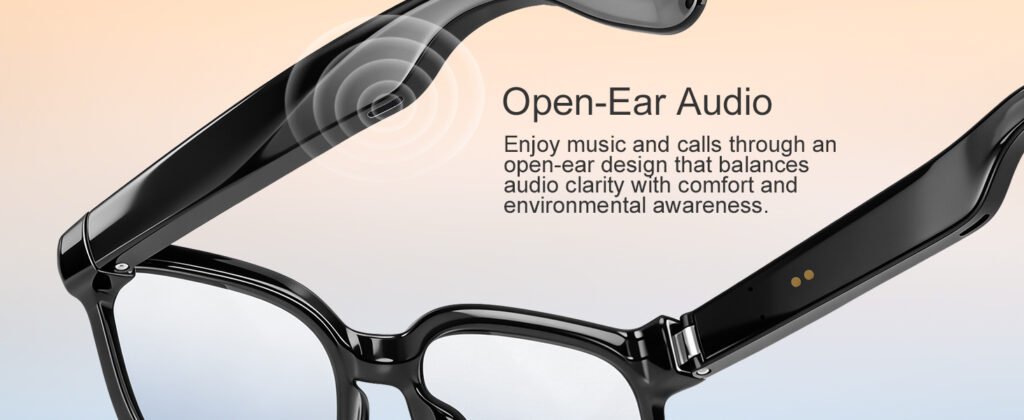
Open-ear audio is a defining feature of premium AI glasses, but its design goes far beyond convenience—it also offers significant hearing protection benefits compared to traditional in-ear headphones.
Unlike earbuds that seal the ear canal, open-ear speakers sit just outside the ear, leaving the ear canal open. This design allows ambient sounds—traffic, announcements, conversation—to reach the wearer naturally, reducing the risk of accidents and keeping users aware of their surroundings. This is especially valuable for outdoor activities, commuting, or workplace environments where situational awareness is critical.
But open-ear doesn’t mean public broadcast. Advanced acoustic engineering addresses the challenge of sound leakage—the tendency of open speakers to let bystanders overhear what you’re listening to. The solution lies in dipole phase cancellation technology.
Here’s how it works: The speaker system has two acoustic ports. The primary port projects sound toward the wearer’s ear, while the secondary port radiates an inverted (180° out-of-phase) sound wave away from the ear. When these opposing waves meet in the air at a distance, they destructively interfere, canceling each other out. This creates an acoustic “short circuit” that dramatically reduces sound energy in the far field—meaning bystanders hear very little, while the wearer enjoys clear audio.
The hearing protection benefit is twofold:
No ear canal occlusion – Users avoid the pressure, discomfort, and potential ear fatigue associated with sealed earbuds, especially during extended wear.
Lower volume exposure – Because the audio is delivered directly toward the ear canal with minimal spillage, users can hear clearly at lower volume levels compared to earbuds in noisy environments. This reduces the risk of long-term hearing damage from excessive decibel exposure.
Manufacturers achieve optimal performance by carefully matching the front and rear acoustic resonance frequencies of the speaker cavities. When these resonances are aligned, the dipole behavior is maintained across a wider frequency range, minimizing spillage while preserving audio clarity.
Multi-language translation transforms AI glasses into global communication tools, while open-ear audio with phase-cancellation technology delivers private, hearing-safe listening. Together, these innovations make smart eyewear a genuinely practical and health-conscious choice for the connected lifestyle.